why make this recipe
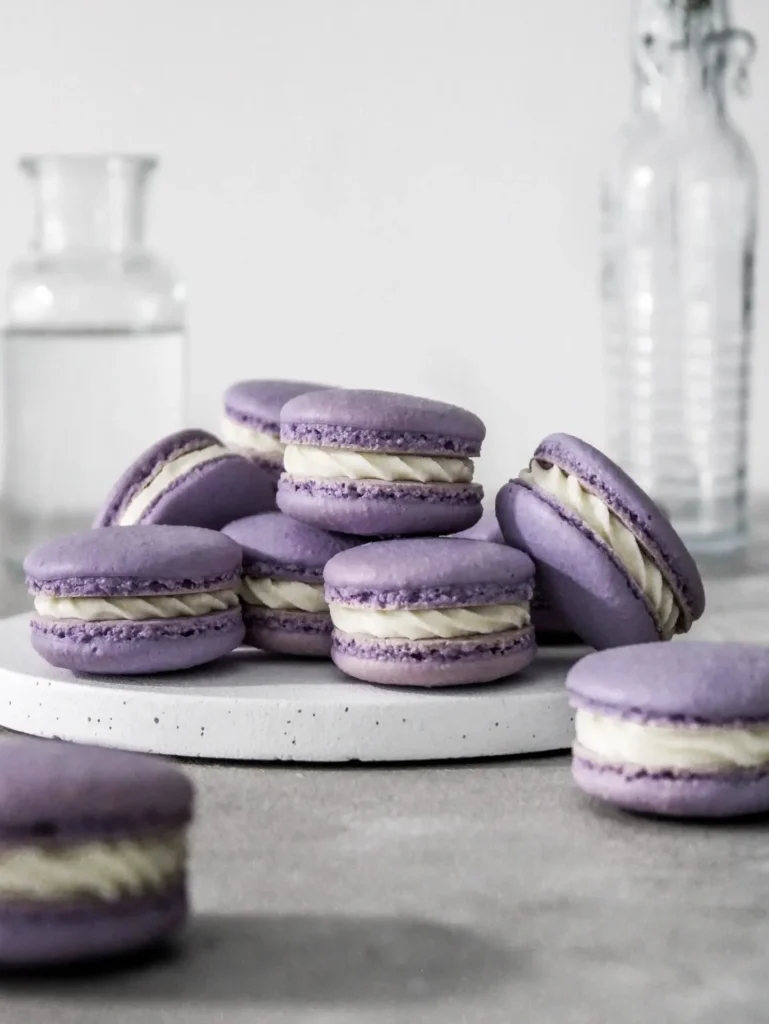
French macarons are delicate and colorful treats that can elevate any dessert table. They are a perfect blend of crispy exteriors and soft, chewy interiors, filled with your favorite cream or ganache. Making macarons at home allows you to customize flavors and colors, giving you endless possibilities. Plus, impressing friends and family with these beautiful cookies is a delightful way to showcase your baking skills!
how to make French Macarons
Ingredients :
- 150 grams sifted super-fine almond flour (measure after sifting *see notes)
- 180 grams powdered sugar
- 1/4 teaspoon salt
- 120 grams large egg whites (at room temperature, about 4 large eggs)
- 60 grams granulated sugar
- 4 drops liquid-gel food coloring (or more for a stronger color ** see notes)
- 1 teaspoon pure vanilla extract
- Vanilla Buttercream Frosting or your choice of filling
Directions :
- Cut the tip off a large piping bag and fit it with a large plain tip. Twist the bag above the tip to prevent batter from leaking. Place the bag in a tall glass, folding the edges over the glass for support. Set aside.
- Sift almond flour into a medium bowl, measuring out 150 grams after sifting. Discard large pieces that didn’t pass through. Sift 180 grams of powdered sugar into the same bowl and mix gently. Set aside.
- Clean a large glass or metal bowl with vinegar or lemon juice to remove any grease. Add 1/4 teaspoon salt and 120 grams egg whites to the bowl. Beat the eggs on medium-high speed until bubbles appear (about 30 seconds to 1 minute).
- With the mixer still running, slowly add 60 grams granulated sugar to the egg whites, beating well after each addition. Be careful to add the sugar slowly, only about 1/2 teaspoon at a time, and whip for 20 to 30 seconds after each addition.
- Continue whipping the meringue until glossy and stiff peaks form. To check for stiff peaks, dip your whisk into the meringue; it should not curl over.
- Add food coloring and 1 teaspoon vanilla to the meringue. Mix to combine.
- Gently fold the almond flour mixture into the meringue in three additions. Once combined, you are ready for the "macaronage" step.
- With a spoon or spatula, mix the batter to gradually deflate it to the right consistency. Keep mixing until it resembles thick lava and falls off the utensil in ribbons. You should be able to draw a figure 8 without breaking.
- Transfer the batter to the prepared piping bag. Avoid spooning the batter in to prevent deflation; tilt the bowl to pour instead.
- Hold the piping bag straight above the baking sheet and pipe shells, leaving about 1 inch between each. Pipe slightly smaller than desired, as they will spread.
- Bang the baking sheet on the counter to release air bubbles. Do this about 5 to 10 times. If bubbles remain, pop them with a skewer or toothpick.
- Let the macarons sit for 30 to 60 minutes until they form a skin that isn’t sticky to the touch. Timing varies with humidity.
- Bake one sheet at a time in a preheated oven at 315°F for 12 to 15 minutes. Test for doneness by gently pressing a shell; it shouldn’t jiggle, and feet should have formed.
- Allow the macaron shells to cool completely. Carefully peel them off the parchment and match similarly sized shells.
- Pipe your chosen filling onto one shell, then sandwich with another.
how to serve French Macarons
French macarons can be served on their own as a delightful treat or as part of a dessert platter. They pair wonderfully with coffee or tea. For special occasions, arrange them in a decorative box or on a cake stand to impress guests.
how to store French Macarons
Store macarons in an airtight container at room temperature for a few days. For longer storage, keep them in the fridge for up to a week. You can also freeze them for up to a month. Just be sure to layer them with parchment paper to prevent sticking.
tips to make French Macarons
- Ensure your egg whites are at room temperature for better volume when whipping.
- Sifting the almond flour and powdered sugar helps remove lumps and creates a smoother batter.
- Be mindful during the macaronage step; overmixing can lead to flat macarons.
- If you live in a humid area, let the shells dry for longer to prevent them from cracking during baking.
variation
Consider experimenting with different flavors and fillings! You can use fruit purees, chocolate ganache, or even matcha for a unique twist. Make the macarons vibrant with different food colorings to match the flavors.
FAQs
-
Why do my macarons crack?
Cracking often occurs if the shells didn’t dry enough before baking or if the oven temperature is too high. Ensure to let them form a skin and bake at the proper temperature. -
How can I get feet on my macarons?
The "feet" of the macarons form during the baking process. Make sure to properly oven temperature and dry the shells adequately before baking to achieve this. -
What’s the best way to pipe macarons?
Keep the piping bag perpendicular to the baking sheet and pipe with consistent pressure to avoid uneven shapes. A template can help for uniform sizing.
French Macarons
Ingredients
Method
- Cut the tip off a large piping bag and fit it with a large plain tip. Twist the bag above the tip to prevent batter from leaking. Place the bag in a tall glass, folding the edges over the glass for support. Set aside.
- Sift almond flour into a medium bowl, measuring out 150 grams after sifting. Discard large pieces that didn’t pass through. Sift 180 grams of powdered sugar into the same bowl and mix gently. Set aside.
- Clean a large glass or metal bowl with vinegar or lemon juice to remove any grease. Add 1/4 teaspoon salt and 120 grams egg whites to the bowl. Beat the eggs on medium-high speed until bubbles appear (about 30 seconds to 1 minute).
- With the mixer still running, slowly add 60 grams granulated sugar to the egg whites, beating well after each addition. Be careful to add the sugar slowly, only about 1/2 teaspoon at a time, and whip for 20 to 30 seconds after each addition.
- Continue whipping the meringue until glossy and stiff peaks form. To check for stiff peaks, dip your whisk into the meringue; it should not curl over.
- Add food coloring and 1 teaspoon vanilla to the meringue. Mix to combine.
- Gently fold the almond flour mixture into the meringue in three additions.
- With a spoon or spatula, mix the batter to gradually deflate it to the right consistency. Keep mixing until it resembles thick lava and falls off the utensil in ribbons.
- Transfer the batter to the prepared piping bag. Avoid spooning the batter in to prevent deflation; tilt the bowl to pour instead.
- Hold the piping bag straight above the baking sheet and pipe shells, leaving about 1 inch between each. Pipe slightly smaller than desired, as they will spread.
- Bang the baking sheet on the counter to release air bubbles. Do this about 5 to 10 times. If bubbles remain, pop them with a skewer or toothpick.
- Let the macarons sit for 30 to 60 minutes until they form a skin that isn’t sticky to the touch. Timing varies with humidity.
- Bake one sheet at a time in a preheated oven at 315°F for 12 to 15 minutes. Test for doneness by gently pressing a shell; it shouldn’t jiggle, and feet should have formed.
- Allow the macaron shells to cool completely. Carefully peel them off the parchment and match similarly sized shells.
- Pipe your chosen filling onto one shell, then sandwich with another.